
The Scold's Bridle
On the very long, very bonkers history of punishing women for speaking - and why we still don't believe them when they do

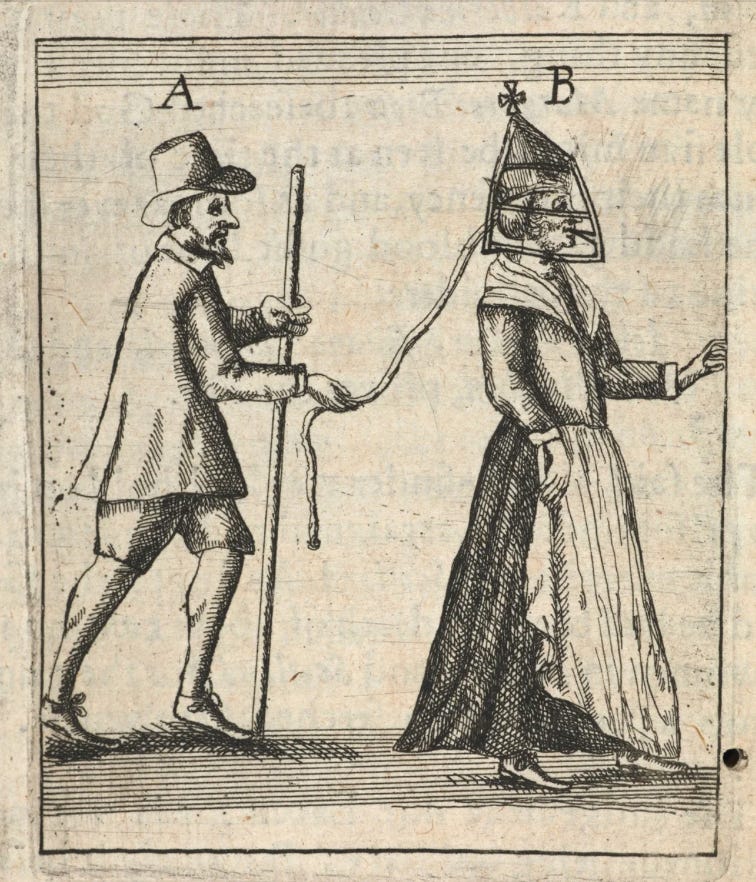
Ann Bidlestone wearing a “Scold’s Bridle”, an Instrument used to cause Pain and Humiliation to Shrewish Women - Newcastle, 1655
CW: descriptions of torture, violence, and subjugation
There is a certain kind of woman who has always made people uneasy.
You know the type I mean, right? She’s shrill, opinionated, difficult. She’s been called opinionated more than once, a bit mouthy. She speaks up for herself, and for others. She’s not dangerous or violent; she just speaks up when she should be quiet. Which makes her unsettling.
History called her a scold.
And then came the torture device.
The scold’s bridle was an iron cage that fitted over the head. A metal bit was forced into the mouth, sometimes it was spiked, and its function was ostensibly to pin the tongue down, though we can imagine it was also to injure the tongue and make it painful for the “scold” to speak for a long time after her punishment: when Ann Bidlestone was bridled in 1655 (image above), records report that the metal bit of the bridle made her tongue bleed profusely.
Note the image below of a bridle with horns - as well as inflicting pain and silent, the idea is also to humiliate the wearer and insinuate her as inhuman, a devil. Some versions of the device had bells attached, so everyone would hear her coming. She was then paraded through the town, where the townsfolk would throw things and piss on her.
All for talking.
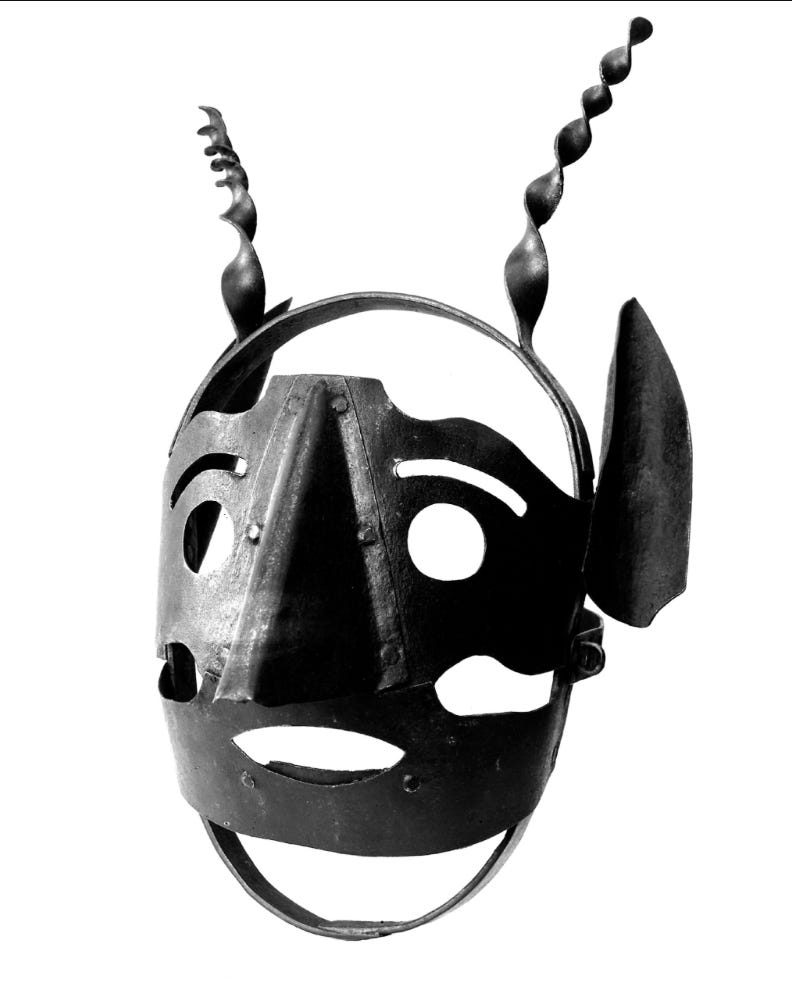
Credit: M0005109: Scolds iron bridle, 14th century Brussels prison. Source: Wellcome Collection.
Women and talking have been a concerning combination since antiquity. In the 8th century BCE, Hesiod describes Pandora - the prototype of womanhood - as possessing “a shameless mind and a deceitful nature.” Three centuries later, in Sophocles’ Ajax (c. 450 BCE), a male character declares that “silence brings honour to a woman.” A century after that, Aristotle describes the female as biologically defective and intellectually inferior, even blaming unruly women for causing the fall of Sparta (Politics 2.9). By the mid-first century CE, a letter to the Corinthians instructs: “Women should remain silent in the churches.”
Here, silence is no longer social expectation but theological instruction.
It doesn’t stop there. Hoo boy, are medieval texts obsessed with women’s tongues. Obsessed! Fourteenth-century English court rolls record women being fined for failing to “control their tongues.” In 1486, Heinrich Kramer writes in Malleus Maleficarum about women’s “slippery tongues” making them prone to deception and demonic influence, their speech a corrupting force. By the time English and Scottish courts were prosecuting the “common scold,” the idea that a woman’s tongue should be stopped was already thousands of years old.
The iron bridle is the material expression of that vast ideological history.
The Latin legal term was communis rixatrix - “common scold.” The feminine ending is not incidental. In practice, the offence was overwhelmingly prosecuted against women.1 Incidentally, the scold and the witch were sisters in the early modern imagination - both women who refused to be silent, both labelled dangerous for it. The same fear that put the bridle on a woman’s face sent another to the gallows.
But the bridle isn’t about punishing speech or noise, oh no. No, it’s about punishing character, see? That long history of silent women is underpinned by entrenched ideas of woman as inferior, unstable, and innately deceptive.
Like Pandora, the very first woman, according to Greek myth.
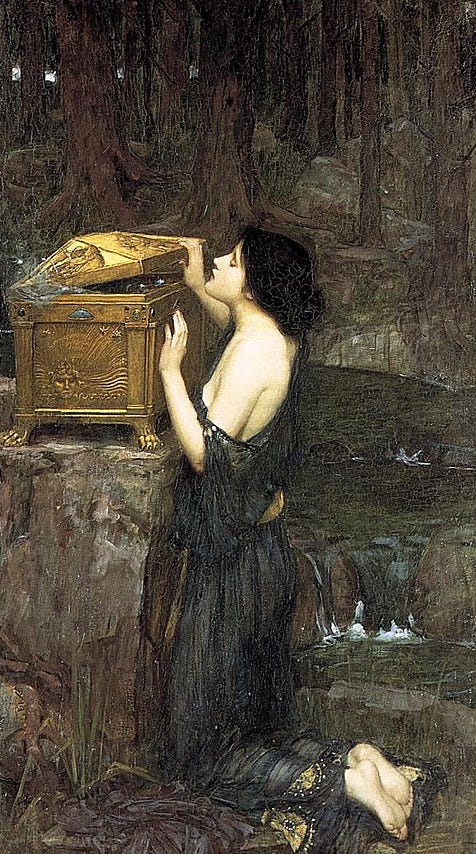
Pandora by John William Waterhouse, 1896
The suspicion of women’s nature we see in Hesiod isn’t an archaic blip - it persists, mutates, and becomes philosophically systematised over centuries. 350 years later, what was mythic in Hesiod becomes “natural law”, as we see in Aristotle’s Politics:
“The male is by nature superior, and the female inferior; the male rules, and the female is ruled.”
And crucially:
The female has a deliberative faculty, but it is “without authority.”
And then, jump forward approximately another 150 years, and Cato the Elder is shouting that if women gain equality, they will dominate men. Perish the thought!
The first recorded use of the bridle was in Edinburgh, 1567. A woman named Bessie Tailiefeir accused a baillie - a local magistrate - of using false measures. She was telling the truth. He was cheating people. But because she told on him, she was sentenced to be bridled and chained to the market cross for an hour.
By the end of the 1500s, every major town in Scotland had its own bridle, often displayed permanently at the Mercat Cross. It was a reminder, a warning specifically to women. Here is what happens to women who speak!
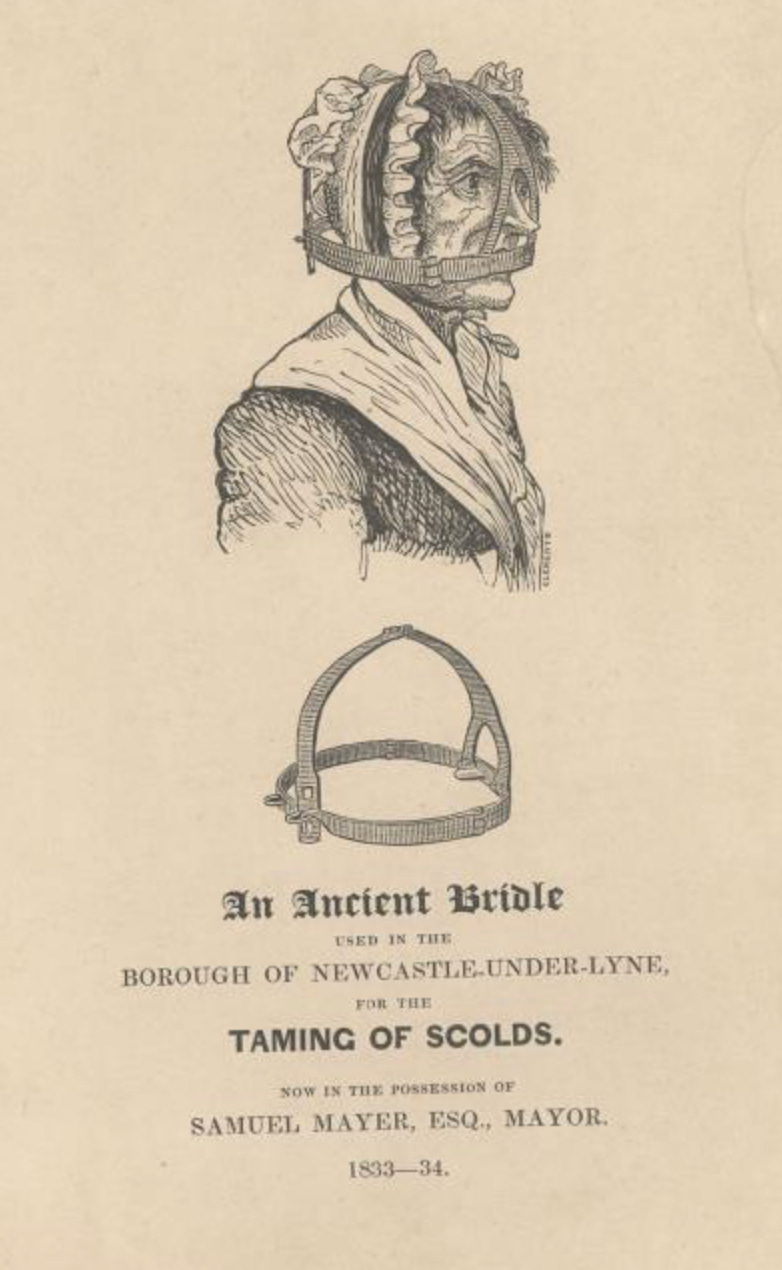
Also knows as “branks”, the bridle was used in Europe from the 14th century, and in the UK, from the 16th century well into the 19th. We’re taking from Shakespeare’s lifetime, the Renaissance: the age of reason, supposedly. We were charting the stars and codifying empirical method whilst strapping iron cages to women’s heads because they talked. How fun for us.
The crime of being a “common scold” remained on the statute books in England and Wales until 1967. Yes, 1967. My mum was 6 years old. The Beatles were recording Sgt. Pepper. Nasa was gearing up to send people to the moon. Abortion and homosexuality began to be decriminalised in the UK. But a woman could still be prosecuted for speaking.
Four centuries of a law that punished women for speaking, and we wonder why we don’t believe them when they speak up. What was the point of parading the bridle-wearing scold about town if not to teach every woman watching what speaking out costs?
We call it silence, but really, it’s not. It’s survival.
By the time medieval courts began prosecuting the “common scold,” the idea that a woman’s speech was disorderly, corrosive, even morally suspect was centuries old. The bridle did not invent silence. It merely enforced what myth, theology, and law had long rehearsed: that a woman who is silent is virtuous, agreeable, and safe. And that a woman who speaks is a problem to be contained.
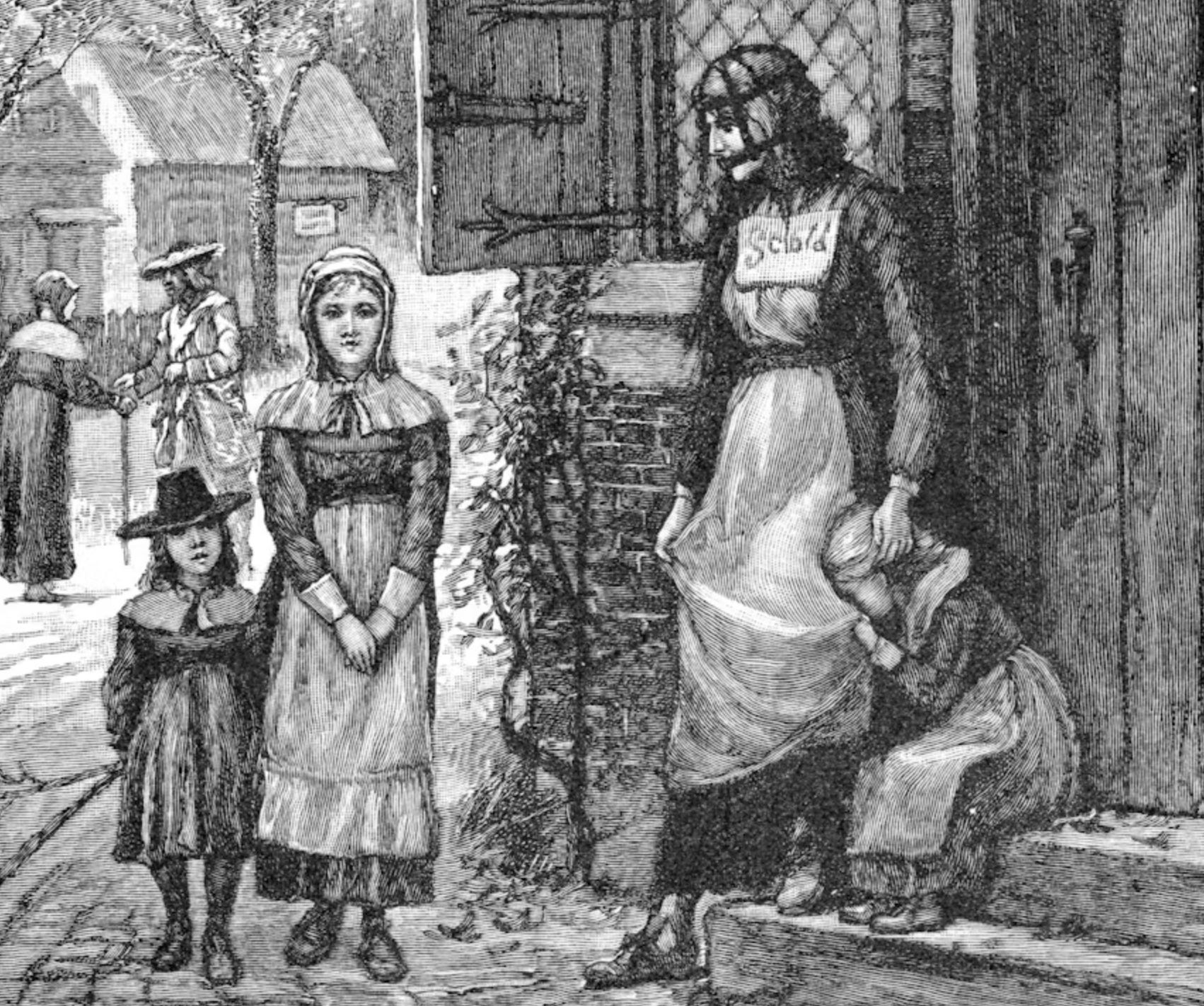
A branked scold in New England, from an 1885 lithograph.
The scold’s bridle did not invent the fear of women’s speech. It inherited it.
The bridle was never only an instrument. It was an argument made of iron. It asserted that some voices are suspect, that order requires their restraint. This argument has been made in myth, in philosophy, in scripture, in law, for millennia.
The bridle is in museums now. Under glass. A curiosity. We look at it and think ourselves beyond such crude methods.
And perhaps we are.
We just don’t use iron anymore.
If you enjoyed this, you might like The Lighthouse Witches, The Book of Witching, or my other writing on women, history, and who gets to speak.
There was, briefly, a male equivalent: the barrator, a “common wrangler” who stirred up trouble with his speech. But the barrator faded from legal use in the early seventeenth century, pretty much when the bridle arrived in England from Scotland. The male crime disappeared. The female one got an update.
Chilling. I first learned of these heinous things in college when I was researching the Berwick witch trials. I didn't see one until this summer at a museum in Italy. I felt nauseous. Those poor women.
Goodness, I don’t know what to say, except this blows my mind and breaks my heart.